


Malatesta Tower of Castel Colonna
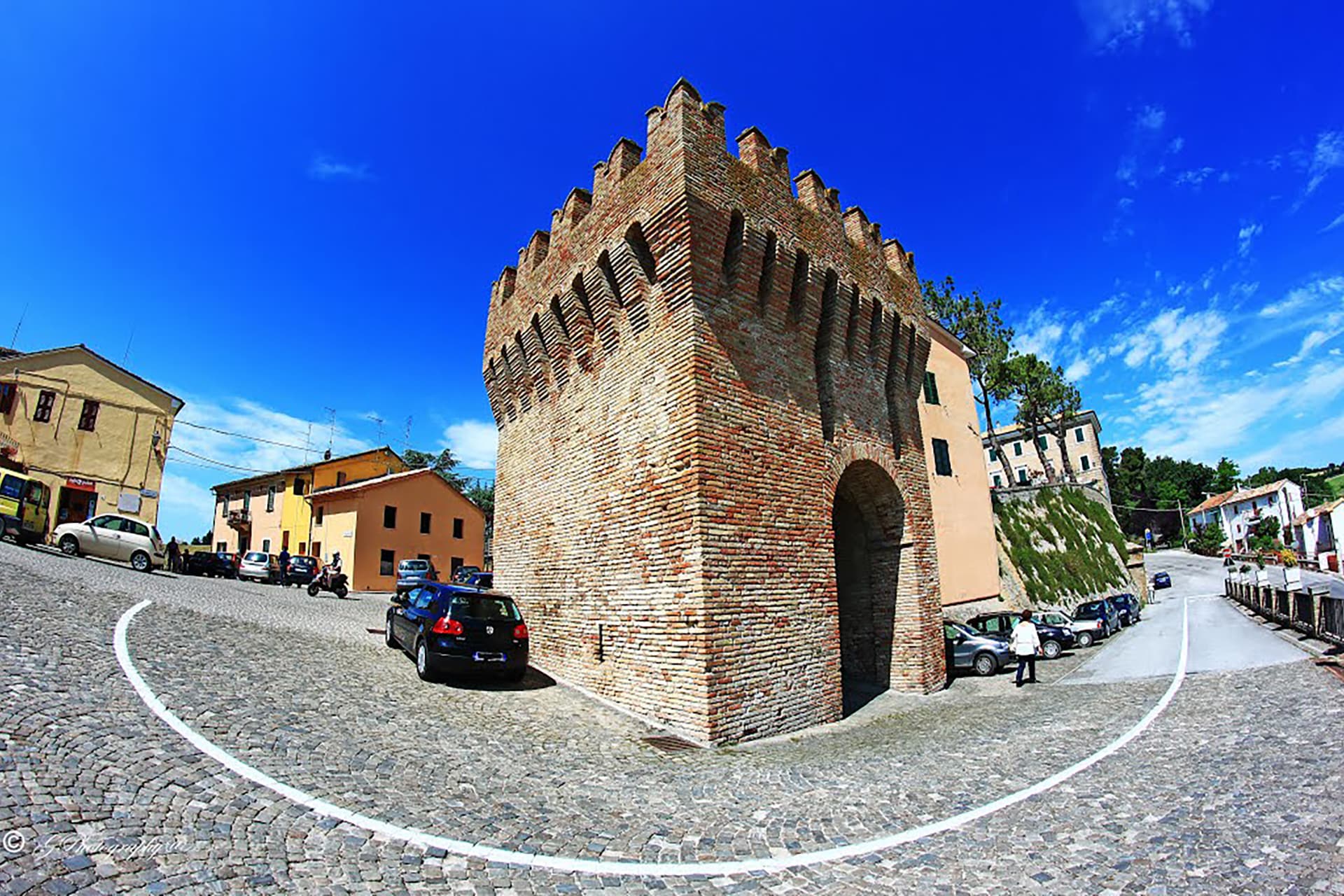
The Malatesta Tower of Castel Colonna, built in 1457 by Vittoria Colonna, is a notable example of Malatesta military architecture. Originally a fortified gate to the castle, it has undergone several restorations while preserving key features like the entrance arch, murder holes, and a commemorative plaque. The tower reflects the defensive strategies of its time and stands as a symbol of the village’s historical identity.
The Malatesta Tower is the oldest and most prestigious monument in Castel Colonna. It was inaugurated on November 3, 1457, by Vittoria Colonna, widow of Carlo Malatesta, who commissioned its construction as a fortified entrance to the castle of Tomba, the ancient name of Castel Colonna.
On a smaller scale, the tower reproduces the typical Malatesta architectural model, inspired by the “Porta Maggiore” in Fano and the “Porta di Sopra” in Corinaldo. Over the centuries, it underwent numerous transformations, to the point that, by the end of World War II, it resembled a tall and narrow house. On the facade facing the square, a public clock had been installed, topped by a small “sail-shaped” bell tower that marked the hours. Only the entrance arch from the original structure remained intact.
In 1958, a major restoration was undertaken. On that occasion, support arches were built for the road leading into the village, and below them a public washhouse was constructed, following the demolition of the dilapidated house above. A cubic turret for a four-faced clock was added to the top of the tower, crowned by a simple iron frame for the bell. Above the arch, a fresco was placed depicting Saint Roch, the Holy House of Loreto, the municipal coat of arms, and that of the Colonna family.
A further restoration in 1975 returned the tower to its original 15th-century architectural form. The Guelph battlements with swallowtail merlons were restored, supported by protruding corbels, above which are the “machicolations” or openings through which boiling oil could be poured on enemies below. It’s worth noting that the side of the tower facing the square lacks battlements—an intentional feature common to many fortified gates (as seen in Fano, Corinaldo, Gradara). This strategic choice left enemies exposed once they reached the top, without the cover of the merlons, making them easy targets for defenders.
The entrance arch is flanked by two vertical grooves that allowed for the sliding beams of the drawbridge, which would be raised at dusk or in times of danger. On the right side of the arch is a marble plaque bearing a dedicatory Latin inscription by Vittoria Colonna:
HOC OPUS FECIT FIERI / MAGNIFICA DOMINA / VICTORIA COLUMNENSIUM / DE MALATESTIS / MCCCCLVII DIE TERTIA NOVEMBRIS
The plaque is framed by two sculpted friezes, each featuring the characteristic four-petaled “Malatesta rose” at the center. Originally, it was topped with the coats of arms of the Colonna and Malatesta families, which were unfortunately chiseled off in 1945, mistakenly believed to be fascist symbols.
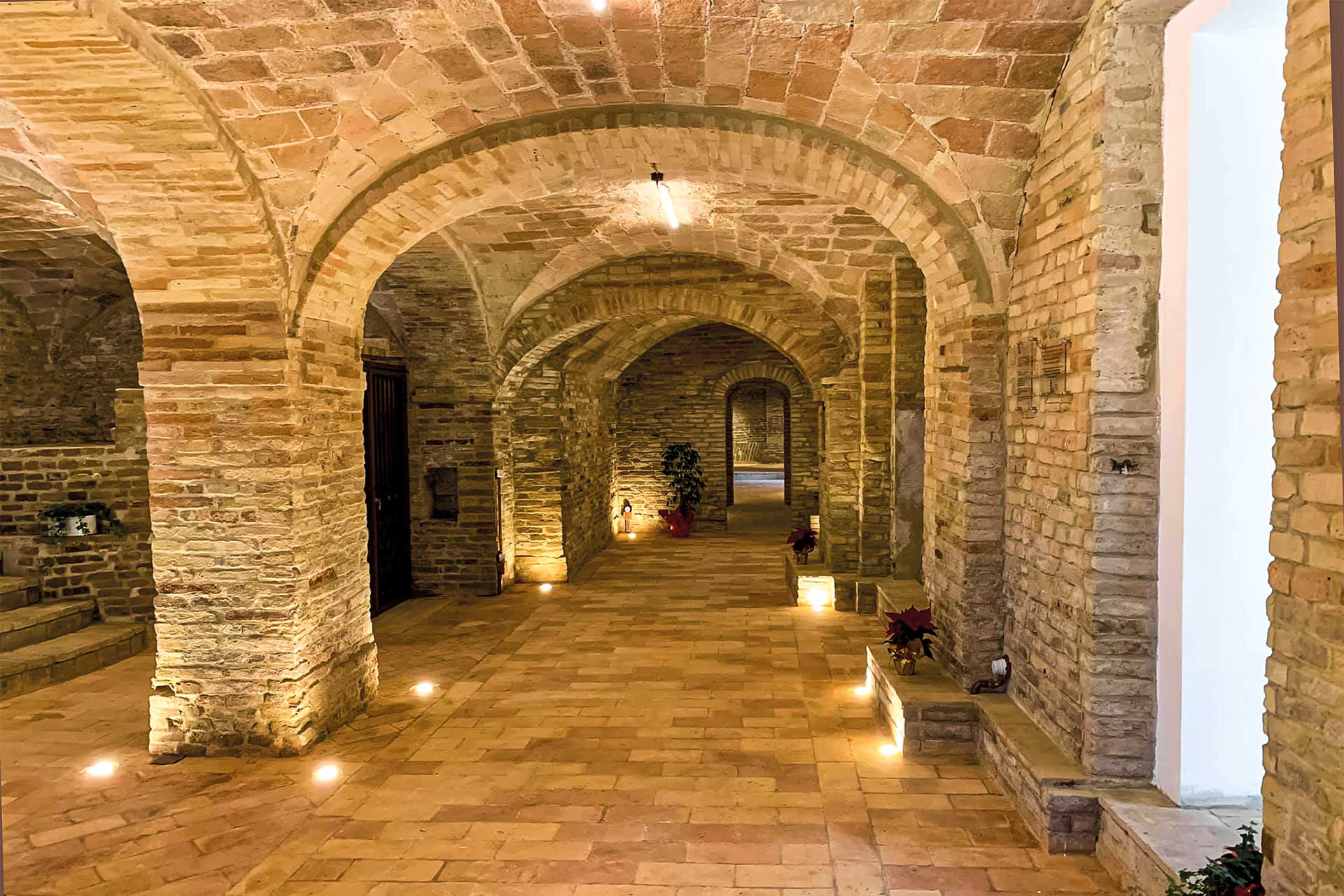
Inside the tower, observing the vaulted ceiling, one can see several walled-up ogival openings. These were likely once connected by wooden walkways, allowing sentries to patrol along the defensive walls. This suggests that the tower was once part of a larger architectural complex, connected to adjacent buildings.
Finally, it should be noted that the tower was once much taller than it appears today; more than half of its height is now buried beneath the embankment over which the village access road runs.
Gallery
Wherein
Contacts
Indirizzo
Piazza Leopardi 3
Social 
More info
Categories
Monumento, Installazione, Architettura
You might also be interested
DIGITRECASTELLI: UN BORGO 4.0 - Questo intervento è stato realizzato con il contributo di 45.000 € dell’Unione europea Bando POR FESR Marche 2021-2027 - Asse 1 - Azione 1.2.2 - Int. 1.2.2.2 Bando per “Servizi digitali integrati” - CUP C61C24000140002


